McCaul Highlights Importance of Cybersecurity Capabilities at Homeland Security Hearing
WASHINGTON – Today, U.S. Congressman Michael McCaul (R-Texas) — chairman emeritus and current vice chairman of the House Committee on Homeland Security — spoke at a full committee hearing titled, “Oversight of the Department of Homeland Security: CISA, TSA, S&T.”
During his tenure as chairman, McCaul authored the Cybersecurity and Infrastructure Security Agency Act and championed the passage of the Cyber Information Sharing Act. During today's hearing, he underscored the importance of both initatives and asked Acting CISA Director Dr. Gottumukkala about their status.
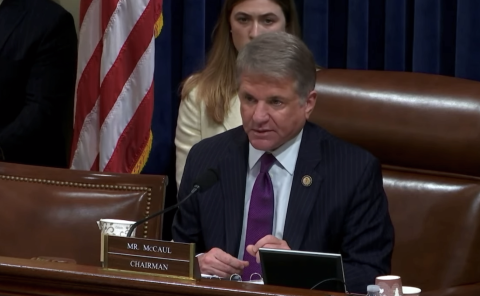
Transcript of McCaul's Exchange:
MCCAUL: Let me just say first, when I was chairman of this committee in 2015, we passed the Cyber Information Sharing Act, the ranking member and I did, together. It’s been a very bipartisan issue. In 2018, we passed the Cyber Security and Information Security Agency permanent authorization. And the reason why I’m going through this legislative history [is] it’s very important to know what is still authorized today and what is not. One of the most critical pieces of CISA as we imagined in Congress was to share information with the private sector — not only to the private sector but from the private sector, which holds about 80% of the cyber threat information. Would you agree with that, sir?
GOTTUMUKKALA: Yes sir.
MCCAUL: So that was vitally important as the authors of this agency, and we had quite a battle, I’d say, with [the House Intelligence Committee] over whether this should be warehoused under the National Security Agency, which is not a civilian agency. To interact with the private sector, we thought a civilian agency would be the better fit. I like to think that we were right about that. But then the goal was to expand the capabilities so that you can meet those requirements. Do you feel that you have those capabilities today?
GOTTUMUKKALA: Sir, the CISA 2015, the Cybersecurity Information Sharing Act that you are referring to, it provides the legal foundation for cyber threat information sharing between the federal government and the private sector, and it remains one of the most important authorities for defending the U.S. critical infrastructure against increasingly sophisticated cyber threats.
MCCAUL: Now let me go back to the authorizations, because this is really important for the committee members to know. Now, CISA the agency was permanently authorized, so there’s no expiration. However, there is one on the Cyber Information Sharing Act, which was brought about by a compromise with various members who would not vote for it unless we put that expiration term in there. So ... it will expire on January 30th of this year. ...
It is not in the Homeland appropriations that we’re voting on this week. My question to you is: While you still have appropriations to the majority of your agency, if not all, to not be authorized — to have a lapse in authorization — at this point in time where the cyber threat is far greater today than when Mr. Thompson and I first created the agency and the [Cyber] Information Sharing Act, in addition coupled with the World Cup FIFA events coming up, the Olympics, and our 250th anniversary of the republic... How does that harm your efforts to protect the nation?
GOTTUMUKKALA: Congressman, thank you again. Like I said, I personally support and DHS also supports the long-term reauthorization of CISA 2015, and I understand that the act expires January 30th. One of the strengths of CISA is the partnership and collaboration with the private sector, and the private sector understands that this will be extended through the continuing resolution. And we have worked with Chairman Garbarino and the committee and the widespread information-
MCCAUL: This is not your fault; this is congress’s fault. I think the [committee] has done its job, but the Senate has not done their job on this. And so it’s vitally important — and this is a message to the Senate — that when we do pass this again, that the Senate reauthorize your mission. Otherwise, your ability to collect 80% of the threat information from the private sector is gone; you’re no longer authorized to do that by law. And so that is why that is so important, sir. And this has, as Mr. Thompson knows, always been a bipartisan issue. I really hope, I don’t have any doubt in my colleagues on the other side of the aisle or in the House that we’re going to get this done, but the Senate, for the sake of the nation and our security, needs to act on this. It is highly irresponsible and quite frankly, it’s just downright dangerous what they’re doing, and they’re playing games with something that’s very serious.
###